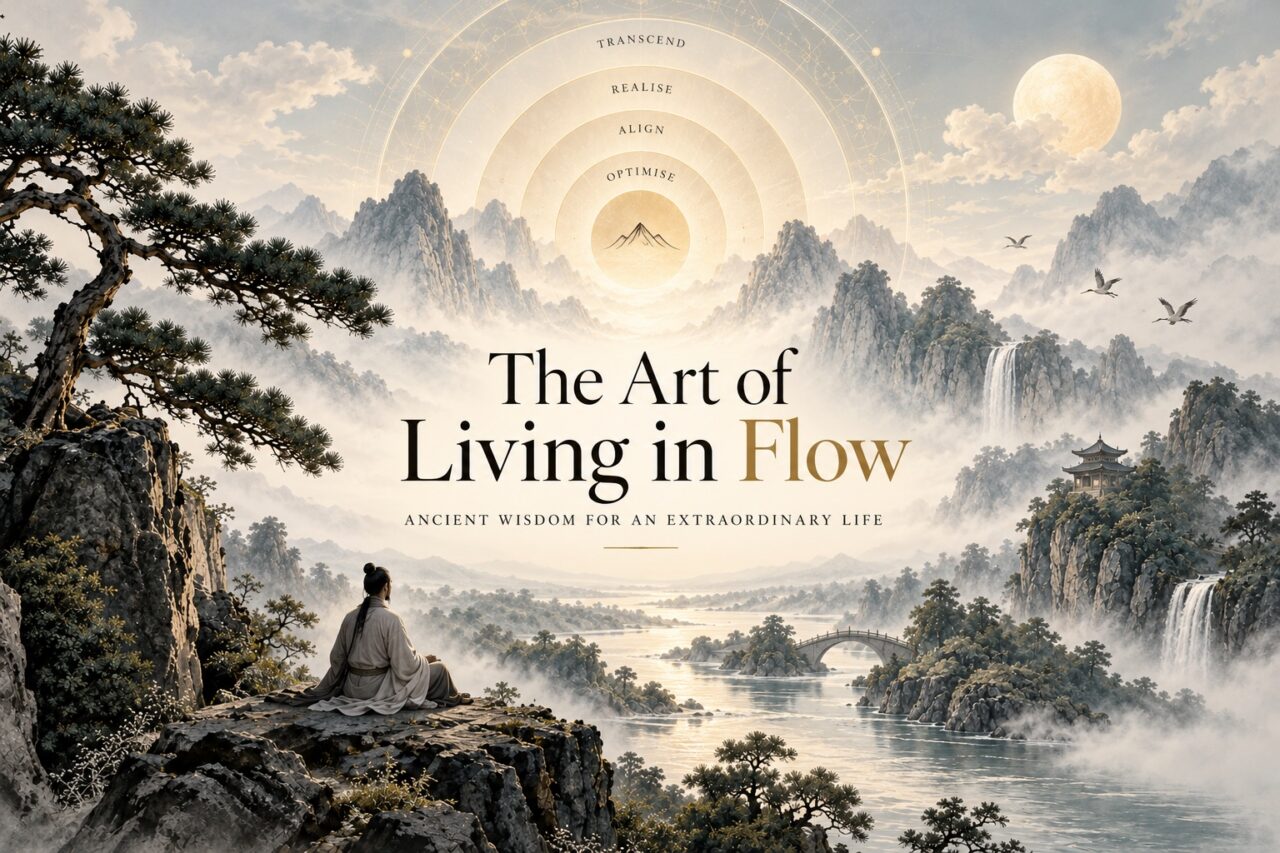
Tao Te Ching: The Book of The Way
Ancient Wisdom for an Extraordinary Life
For thousands of years, human beings have been trying to figure out how to live a good life. How to become successful, avoid suffering, find happiness, build meaningful relationships, and make sense of a world that doesn’t always cooperate with our plans.
We’ve developed religions, philosophies, sciences, governments, and entire industries dedicated to answering these questions. And yet, despite all our accumulated knowledge, many people spend their lives struggling against the very nature of life itself.
More than 2,000 years ago, an ancient Chinese text offered a radically different approach.
The Tao Te Ching, traditionally attributed to Lao Tzu, is one of the great works of human wisdom. Its 81 short chapters explore the nature of reality, the relationship between opposites, the art of leadership, and what it means to live in harmony with the universe.
What makes it extraordinary is that so much of its wisdom runs directly counter to what we have been taught about success, achievement, power, and control.
And perhaps that’s why it remains so relevant today.
Life Doesn’t Move in Straight Lines
Look around you. Where in nature do you find a straight line?
Rivers bend. Trees branch. Planets orbit. Seasons come and go. The tides rise and fall. Everything moves through cycles of growth, decline, renewal, and transformation.
Yet human beings have developed an extraordinary attachment to straight-line thinking.
We expect our careers to progress continuously upward, our businesses to grow every year, our relationships to remain permanently harmonious, and our lives to become progressively better.
And when reality doesn’t cooperate, we become frustrated.
The Tao Te Ching reminds us that opposites are not independent of one another. They exist in relationship.
Long and short define each other. Difficult and easy give meaning to each other. High and low are relative. What we call success only makes sense because we have a concept of failure.
Without darkness, how would we recognize light?
These distinctions are useful. The problem begins when we mistake our interpretations for reality itself.
We label an event good or bad, a person right or wrong, an experience positive or negative. Then we react emotionally to the labels we’ve created.
Something happens. We decide what it means. And before we know it, we’re having a wonderful or terrible day based largely on the story we’re telling ourselves.
The universe, meanwhile, continues doing what it does. Entirely unconcerned about our opinion.
The Problem With Trying to Control Everything
Much of modern life is organized around control.
We try to control our circumstances, our future, our employees, our partners, our children, and occasionally even the weather. When things don’t go according to plan, we push harder.
More effort. More rules. More pressure. More control.
Sometimes this works. Often it creates precisely the resistance we’re trying to overcome.
Consider water.
Water is soft, adaptable, and yielding. It doesn’t argue with a rock. It flows around it. Yet given enough time, water can reshape mountains.
It is one of the most powerful forces on Earth, not because it is rigid, but because it isn’t.
The Tao Te Ching repeatedly returns to this paradox: softness can overcome hardness, yielding can be stronger than resistance, and the desire to control can become the very thing that prevents us from achieving what we want.
This doesn’t mean we should become passive, abandon our ambitions, or allow people to walk all over us.
It means learning the difference between effective action and unnecessary struggle.
And that distinction can transform how we live.
The Paradox of Effortless Action
One of the central concepts of Taoist philosophy is wu wei, often translated as non-action or effortless action.
At first glance, it sounds ridiculous. How can you achieve anything by not doing anything?
But think about an exceptional athlete, musician, dancer, or martial artist.
When they are performing at their best, they are not consciously calculating every movement. Years of preparation, practice, and experience have developed a level of mastery where action happens naturally.
They are completely engaged, yet there is no unnecessary effort.
They are in flow. In the zone.
The same principle applies to leadership. An inexperienced leader often tries to control everything. A masterful leader creates the conditions in which other people can perform extraordinarily well without constant intervention.
In relationships, we can spend enormous amounts of energy trying to change someone else. Or we can become more present, understanding, and responsive, allowing the relationship to develop without constantly imposing our expectations.
In business, there are times to push and times to pause. Times to expand and times to consolidate. Times to lead from the front and times to step aside.
Wisdom is knowing the difference.
Effortless action is not the absence of action. It is the absence of unnecessary resistance.
The Tao and the OPTIMA Zones
This ancient wisdom has a fascinating connection to what we teach through Goldzone and the OPTIMA Zones.
The OPTIMA Zones describe different states of being and how those states influence our perceptions, behavior, relationships, decisions, and results.
When operating in lower zones, we tend to experience more fear, resistance, rigidity, reactivity, and the need to control. Our attention narrows. We become attached to particular outcomes and find ourselves struggling against circumstances that don’t match our expectations.
As we move into higher zones, our relationship with life begins to change.
We become more aware, adaptable, accepting, creative, and capable of responding appropriately to whatever is happening.
The circumstances around us may not have changed at all. What changes is our state of being and, with it, the possibilities we can perceive.
This is a critical distinction.
Living in a higher zone doesn’t mean that life becomes permanently pleasant, that difficulties disappear, or that we stop experiencing the full range of human emotions.
It means we become less controlled by our automatic reactions.
Instead of fighting reality, we can acknowledge it. Instead of becoming trapped in judgment, we can become curious. Instead of demanding that life conform to our expectations, we can work intelligently with what is actually happening.
This is where being and doing come together.
Our way of being influences the quality of our actions. The quality of our actions influences the results we create.
And when our internal state is aligned with the reality around us, extraordinary things can become possible without the enormous struggle we once considered necessary.
This is not about pretending that everything is wonderful. Nor is it about giving up responsibility for our lives.
Quite the opposite.
It is about becoming sufficiently aware and capable that we can respond to life rather than spend our lives reacting to it.
Understanding Is Not Living
There is another wonderful paradox in the Tao Te Ching.
It attempts to explain something that, by its very nature, cannot be fully explained.
The opening chapter tells us that the Tao we can describe is not the eternal Tao.
In other words, our words, models, concepts, and explanations can point us toward reality, but they are not reality itself.
This is worth remembering in an age when virtually unlimited information is available at our fingertips.
You can read a thousand books about swimming and still drown when you jump into the pool.
You can study leadership for twenty years and still be unable to lead yourself.
You can understand everything about emotional regulation and still lose your temper when someone pushes the right button.
Knowing is not being. And understanding is not living.
Goldzone is built around this distinction. Information has value, but transformation happens when we embody what we learn and apply it in the circumstances of our everyday lives.
The Tao Te Ching is not asking us to believe in another system of ideas. It is inviting us to observe life, question our assumptions, experiment with a different way of being, and discover what happens.
Perhaps the greatest invitation is also the simplest.
What would become possible if you stopped fighting life and started working with it?
I’ve included the complete audio recording of the Tao Te Ching below. I encourage you to listen to it, perhaps more than once, without feeling the need to understand or agree with everything.
Some passages may seem obvious. Others may appear contradictory, impractical, or downright absurd.
Wonderful.
Let them challenge your thinking.
You may discover that the greatest changes in your life don’t come from learning to do more, but from discovering an entirely different way of being.
And that changes everything.
⚜️

Founder of Goldzone Group and the primary author of Renaissance for Leaders. Harrison’s work focuses on the study of leadership and the conditions that shape human performance and decision-making.